

Never have I ever replaced my sales deck with a single web page
Season 10, Issue 5: Is this actually the ultimate hack for getting rid of deck requests?
📬In this issue:
Taking a look at Hubspot’s single web page that replaces their sales deck
The line between a deck and a proposal (and can they be the same?)
What actually is the perfect meeting 1 > meeting 2 > proposal > contract process?
G’day Mehketeers,
I am back from my holiday and once again back on my bullshit, writing this the night before it’s being sent out. Once again, old habits die hard. In my last minute dash to put this together, I put three topic options in the Mehdeeka WhatsApp community and had people vote for which one they wanted, and to my delight the first person to vote on this was actually the person who tipped me off about it (you know who you are…)
I am not particularly active on the WhatsApp, I initially envisioned it as a place to discuss each issue as they came out but 1. I don’t actually put the work in to initiate that discussions and 2. Mehketeers are all lurkers (which, same.)
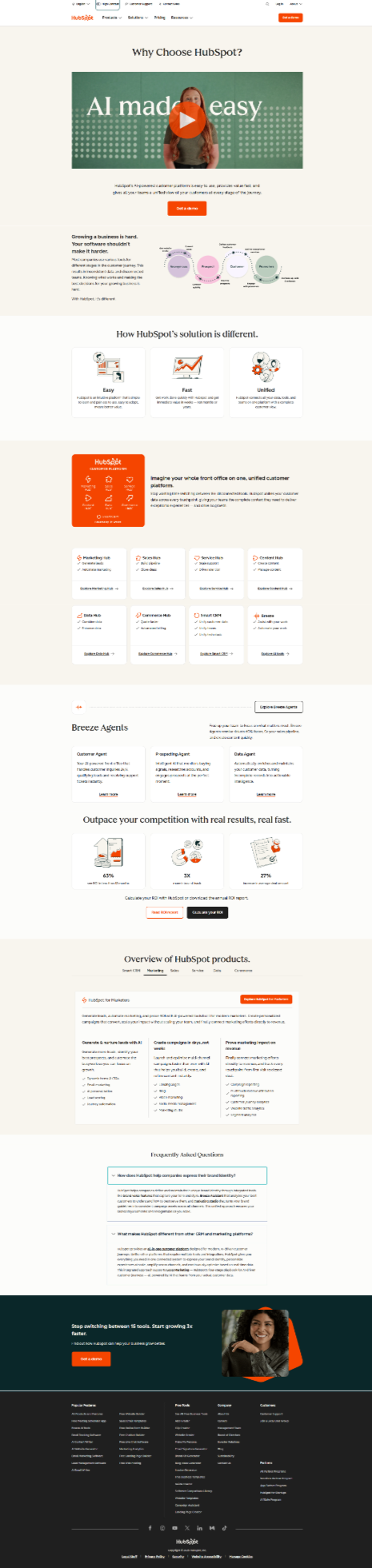
SO, I got an inside tip that the Hubspot sales team had actually done away with the whole concept of a “pitch deck” and instead replaced it with a web page, that all sellers use during presentations.
It would be so annoying/embarrassing if they ever change the link, so I’ve included a full page screenshot further down this email. Here’s the link for now:
Now, my insider wasn’t from the Hubspot marketing team so I’m making some assumptions here but, I would bet that this page is somewhat regularly updated, but maybe not experimented on (too risky if it’s genuinely being used by 100% of the sales team.) I’d also guess that they’re strict about using tracking links on this page when they send it to prospects to see who’s opened it, how far they’ve gotten, and whether they click any of the links.
Okokok, what is the page?
So, when a sales person at Hubspot does a “sales presentation”, they use the web page instead of a presentation deck. Just pull it up, scroll, talk through, scroll, and so on. It has everything they need to talk through, helps them stick to the script, and acts as a “one pager” or leave behind where they can give the link to the prospect.
Quick side note: If you’re on the starter/startup/whatever the smaller tiers of Hubspot, you are not likely to have come across this as they have a self-serve signup for that size.
What’s most interesting is the sales team can’t edit it, go wild, insert their own DIY slides, or otherwise insult the existance of marketers with some Frankenstein deck.
What I like, and what I don’t like about the page
The pros
The content is so streamlined and broken into perfect segments:
The problem (Growing a business is hard)
How Hubspot is different
The promised land (Imagine your whole front office…)
Product overview, and a succinct one at that!
Value propositions and ROI
Breakdown by user persona (using team/function)
FAQ
In terms of the page actually just being a thing that exists, I do really like the idea of it.
It’s almost a bell curve situation, where really small teams who need to move fast, and really big teams that are unwieldy and hard to control will have amazing results with something like this providing structure and consistency.
A mid-sized team might benefit from more bespoke decks, with a higher level of personalisation to the prospects it’s being shared with.

Are you the person in your org who works on pages like this, and your pricing page? Then you’ll want to come along to my Pricing Masterclass, in Melbourne on Nov 26! Syd dates being announced shortly - register your interest via the same link:
The things I like less
I’m kinda shocked to see a company as big and “cutting edge” as Hubspot with a video as the media choice for their hero section, and it’s only right at the very end of the video that I realise the people in it are (supposed to be?) customers and not Hubspot employees…
I don’t particularly love the value propositions and positioning they’ve chosen to go with the ROI, to me why bring up a customer’s competitors at all? It unnecessarily brings another character into the narrative.
The design of the page could be less “web page” and more pizazz? For example, removing the navigation bar would increase the vibe of this being a “special” page. Additional images (including of the product, of which there are none) or subtle animations would not go astray.
There are no case studies, testimonials, or pricing, or solid actual description of what Hubspot is! They call it a “customer platform”, but honestly I don’t know anyone who actually uses it that would call it that.
When should something like this (or a traditional deck) be used?
Well, eagle-eyed Mehketeers will note that the video on the page has some sales stages in it. Whether or not Hubspot actually uses these, TBD, but they’re a good benchmark.
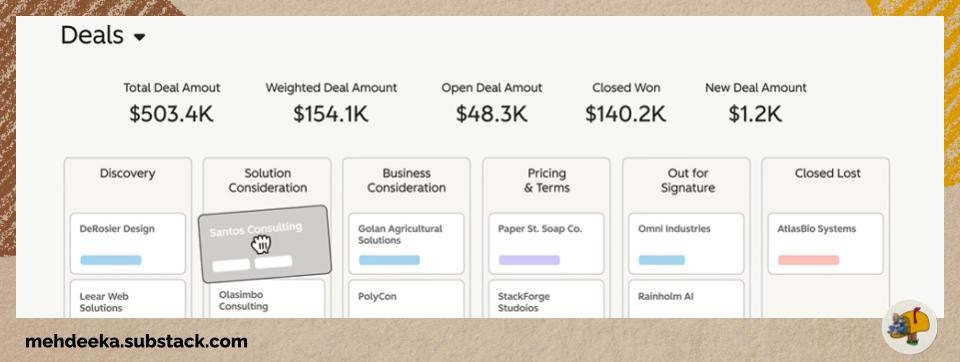
One thing that never ceases to amaze me is how many sales teams don’t do discovery. Anyway, here are the stages as shown in the Hubspot video and what resources I’d map to them (depending on your product, target audience, etc, you might change it up.
Discovery
No assets, just a phone(/video) call. Should be following a script and standardised qualification questions. Once a persona/ICP has been identified, then relevant assets (could be blogs, pdfs, videos, links, whatever) are sent in follow up materials.
Best efforts should be made to book in the next call before saying goodbye (if they meet qualification.)
Solution consideration
Deeper dive into the problem and solution. This could be where an SDR hands over to an AE, too. Is your product a fit for the problem?
Assets would include a brief overview deck (or web page) and potentially a live demo.
Again, relevant assets should be sent as follow ups, and best efforts should be made to book the next call in before hanging up. Relevant assets might be more technical overviews, case studies, or otherwise “meatier” assets specific to the problem.
Business consideration
These are Hubspot’s words, so I’m taking some liberties with the interpretation of what they are (for the record, I like them.)
This could be where you’re put in front of a wider buying group. You might have finance and IT involved, or other stakeholders.
A polished presentation should be prepared, but also be prepared to ditch it if they’re wanting more of a Q&A session.
Note: There could be multiple meetings here. If you have good product documentation and preparation you should be fine to not have to make new assets for every meeting in this stage. Case studies, ROI, deeper exploration of specific use cases, support documentation, and other product-heavy docs will come in here.
Pricing and terms
Technically, pricing and terms are a proposal. Terms could be summarised or not fully fleshed out (for example, saying it is $X per user, but not stipulating how many users they’re signing up for.)
Out for signature + Closed won/lost
If your pricing and terms is the shorter version, then your contract will be the full length thing that you get them to sign. Savvy legal teams will have a process where everything is negotiated and a single contract is sent out and signed. Having contracts coming back and forth is a huge stress you want to avoid — but this isn’t really marketing’s job.
What do you think?
Did this issue give you thoughts? Tell me them in the WhatsApp group and make sure you join the channels that allow you to post! I’ll actually monitor it as this issue goes out this time.
Thanks to the voting, the next two Mehdeeka topics have also been decided, so I’ll work on not writing them the night before.
P.S. if you’re interested in the pricing masterclass but you have limited L&D budget just reply to this email, I’ll always hook a Mehketeer up.
Till next time,
Kayla