

Free coffee, newsletter growth experiments, and small teams
Season 10, Issue 4: An interview with Belle Taylor from Capital Brief
📬In this issue:
Is giving out free coffee actually the best marketing tactic?
How Belle Tayler runs brand and subscriptions growth at Capital Brief as a small marketing team of 2
Newsletters as a growth channel
Annyeong, Mehketeers!
Today’s interview with Belle Tayler comes to you from Seoul. Don’t forget to join the Mehdeeka chat to follow the marketing examples I find while travelling.
Belle was the first marketer to join Capital Brief (support independent journalism!!!!!!) and is currently one of only two marketers total (shout out to Harsh!)
Belle’s marketing ideas first caught my eye when Capital Brief did a free coffee activation at Diggy Doos in Martin Place, which, for the Sydneysiders FYI, does a great matcha. I went and was greeted by the Capital Brief team talking to literally every person in line.
As someone who was already a paying subscriber, they gave me stickers. Now, every time someone sees the one on my laptop I get a very aggressive “how did you get that?!”
Aside from the free coffee/matcha, I was also spotting experiments in the newsletters.
Capital Brief is an interesting product to look at, because it’s subscription-based, much like SaaS, but the product itself is the news/content. It’s inherently time bound with most pieces likely to have a short shelf life (in comparison to a product.)
It covers both B2C (selling individual subscriptions) and B2B (selling to companies for all their employees), and the product is mostly paywalled. And that was pretty much the jumping off point for this interview!

Growth and experiments with Belle
Kayla: I’m interested to explore what “growth” means for Capital Brief. How does the dynamic of the product as described above influence the way you, as a marketer, think about growth?
Belle: Media is all about product-led growth. The newsroom is the product engine room of the business: they’re under the pump daily to ship, reporting news that’s genuinely valuable to a high-value, time-poor audience. Marketing’s role is to accelerate the natural velocity of the news and turn that demand into revenue.
So it’s making the journalism travel further, building name recognition, and keeping us persistently in front of the right people. Media brands should feel like part of the furniture. And then be really efficient at turning product consumption into revenue, which moves at two speeds.
The first is the quick decision to subscribe, usually triggered by either a must-read story or a last-straw moment. There’s only so many times you can hit a paywall or see the juiciest part of a story redacted before the credit card comes out. We need strong levers in place to make that decision as easy as possible: the right offers, messaging, prices, comms and so on.
The second speed is the longer-term pipeline play. Our readers are also the decision makers for bigger corporate subscriptions and commercial partnerships across corporates, banks, law firms and government departments. Fostering this demand is classic B2B: build the brand, build relationships, grow internal demand, the usual pipeline management.
When all this works as it should, it’s a virtuous circle of product driving growth driving revenue driving product driving….It always comes back to the product. The newsroom does the hard work, marketing just gives it leverage.
K: I’m a big fan of the Capital Brief newsletters, and I’ve noticed quite a few little experiments in them in the time you’ve been there. Can you tell me more about the role the newsletter plays in growth, and what your involvement with them is?
B: Our newsletters are great! My involvement in their development is nil! They’re magic vehicles for building habit with readers and allowing our journalists to expand on their reporting with more context and insider insight. All credit to the newsroom for how good they are.
That said, they’re also killer as a marketer to experiment in. Constantly. It’s the PLG growth I mentioned earlier in action: the newsroom builds, marketing leverages. Aside from the paywall, there’s no better channel where we’re able to get in front of our best prospects every day and nudge toward their next best action. Some of the experiments you would’ve seen:
Intro and trial offers.
Nudging word-of-mouth referrals.
Pushing group subscriptions.
K: What’s been the most successful experiment you’ve run?
B: My favourite experiments are the ones that others want to steal and that we can spin into bigger initiatives.
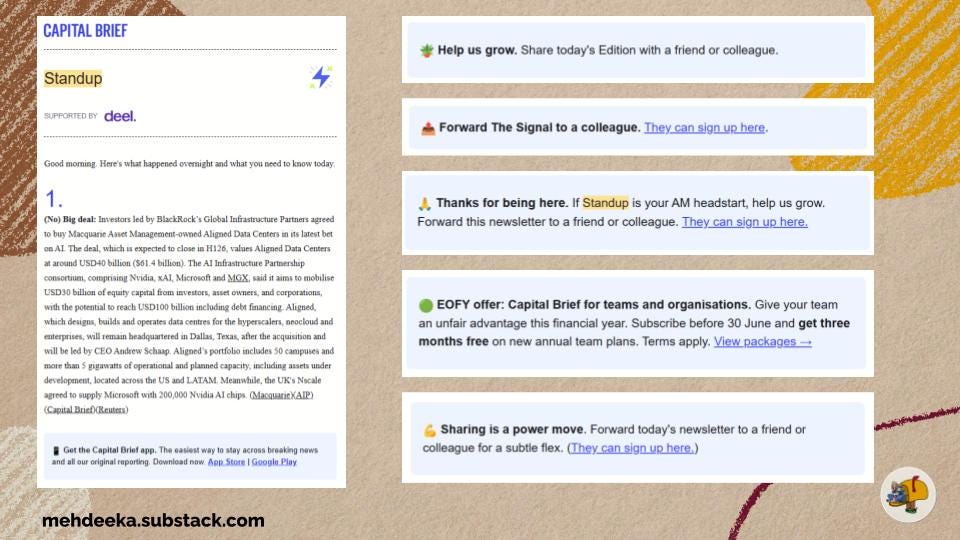
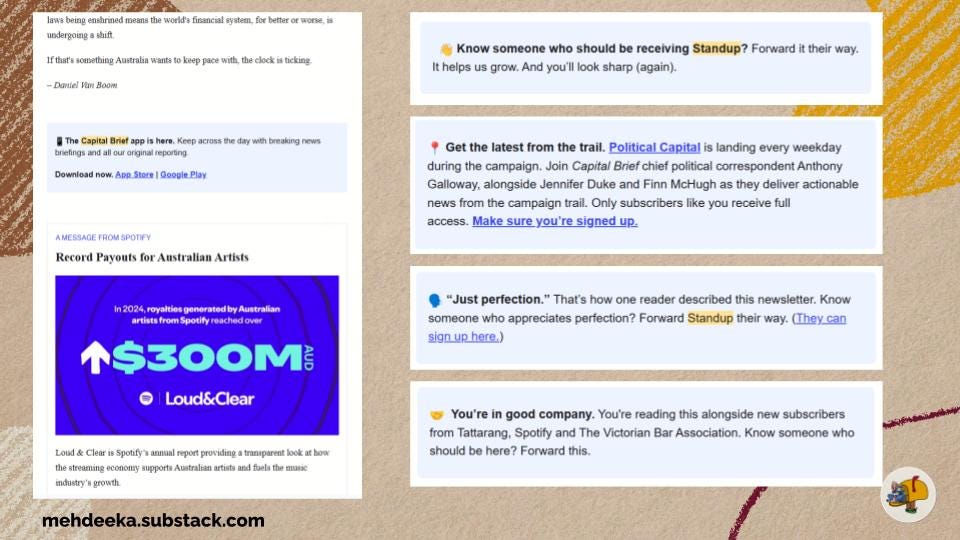
One experiment we ran involved a message inserted into our daily newsletters that name-dropped our top domains for new sign-ups from the past week, with a simple ask to forward that day’s newsletter.
(Note from Kayla: you’ll see the examples of what Belle’s talking about here in the images in this issue)
The hypothesis was that if Bank X saw Bank Y leading in new readers, Bank X would quickly catch up. And so on for law firms, gov departments, consulting firms…Metrics to prove this are tricky, but it was undeniable that many people noticed the name drop. (I’ve got to bring this one back.)
Another favourite was the earliest iteration for On The Call during the election campaign. We had already accelerated Political Capital, our politics and policy-focused newsletter, from twice-weekly to daily. But every newsroom in the country was investing in their election coverage too.
We decided to try something new. A half-hour call with our newsroom to dissect what they were seeing on the ground, plus a live Q&A. The first one was literally a calendar invite from my own diary with a Zoom link. Limited to 25 subscribers.
That first On The Call filled up instantly with an audience of senior business leaders, corporate affairs heads and policy professionals, people who don’t add a 30 min call to their workday diary unless it’s for a very good reason. It gave us the market feedback to turn On The Call into a weekly live event with a rotating cast from our newsroom, and hosted by our own Harshdeep Kaur.
K: How do you keep coming up with such creative ideas (such as the Diggy Doos collab) when you’ve got a super limited budget and team of two marketers?
B: After a year in this role, I’d almost flip this question. How do large teams with large budgets ever come up with creative ideas? Constraint forces you to keep things stupidly simple. And stupidly simple is often quite smart.
E.g. Our audience works in Martin Place. They get coffee on their way to work. We want this audience to see Capital Brief as desirable. So, let’s create a line around the block in Martin Place by offering free coffee at the Diggy Doo’s kiosk. This went off. Three days of target audience buzz around Capital Brief in a physical space that would otherwise be $$k+ to buy our way into.
The reason this worked is because it delivered on the basics of good brand strategy and media planning: find your audience and show up. But they also worked because they’re, again, stupidly simple.
Where is your audience, really? What are they doing, really? And what do you want them to perceive about your brand, really? Dumb ideas welcome.
K: How are you juggling focus between long term and short term marketing as a small team? What are you currently working on?
B: Capital Brief is two years old. I’m one year into this role. In a sense, all work is short term because it’s based on immediate opportunities, trends we’re seeing, holes we want to plug. But all this short term work is long term work if we learn something and build a better growth engine. Short term, long-term: ¿por qué no los dos?
Some current priorities:
We’ve recently launched the Capital Brief app, weekly live conference calls with the newsroom, and the ability for contributors to share gift links with their networks. These are all new PLG levers that we’re building playbooks around: how to use them to attract new users, drive conversion and retain subscribers.
We’re also working on what’s glamorously called ‘subscription hygiene’: reducing friction at key points of acquisition (please verify your email address), credit card failure (we’ve all had insufficient funds and that’s okay), and ensuring sticky habits like downloading the app are on a subscriber’s to-do list on Day 1.
Aside from that, we’ll see what’s news.
I really suck at writing these outros
Next week’s issue will be sent from the comfort of my own home! Catch up on the marketing I’ve spotted along my travels and be inspired? Curious? by joining the Mehdeeka chat:

See you again real soon,
Kayla
❤️ Capital Brief
❤️ This interview